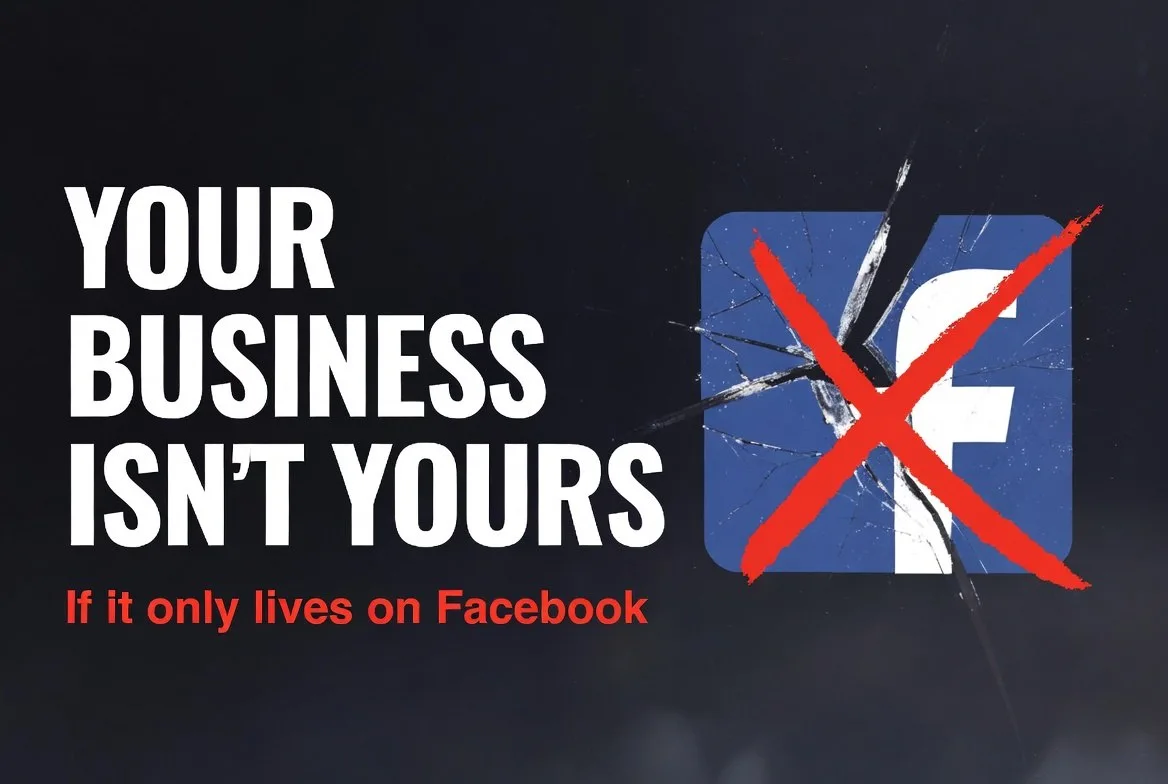
Facebook deleted a business yesterday. No warning. No appeal. No explanation. Just gone. Years of posts, reviews, followers, leads. Wiped. And the owner had no backup, no website, no way to reach their customers.
It happens every day. And if Facebook is the only place your business lives online, you're one report, one algorithm change, one policy update away from the same thing.
You built something real. Don't let a platform you don't own decide if it survives.
But here is the thing: Facebook is not your business's home. It is a rented room in someone else's house, and the landlord does not care about you.
You Do Not Own Any of It
When you post on Facebook, you are building on land you do not own. Your page, your followers, your posts: all of it lives on Meta's servers under Meta's rules. You have no contract. You have no rights. You are a tenant with no lease.
This is not hypothetical. Ask any small business owner who woke up one morning to find their page restricted, unpublished, or gone entirely. No warning. No explanation. No customer service number to call. Just gone. And with it: years of reviews, photos, post history, customer contact.
If your Facebook page disappeared tomorrow, what would you actually have left?
You are a tenant with no lease, no contract, and no rights. That is the business you built on Facebook.
The Algorithm Does Not Owe You Anything
Remember when Facebook pages got decent organic reach? That era is over. Organic reach for Facebook business pages has been declining for years and now sits well below 5% for most pages. If you have 500 followers, fewer than 25 people might see your post on a good day.
And when Meta decides to tweak the algorithm, which they do constantly, your reach can drop overnight. No heads up. No transition period. Just suddenly, nobody is seeing your stuff.
You can pay to boost posts. But now you are paying rent on top of rent.
Google Cannot See Your Facebook Page
When someone in Concord, NH searches "best [your service] near me," your Facebook page is not what shows up. Google can see some Facebook content, but it cannot index most of it the way it indexes a real website. You get no SEO value from years of posting.
A website with the right content, structure, and local signals can rank. A Facebook page mostly cannot. So while you have been spending time posting updates, your competitor with a basic but well-built website has been quietly collecting every Google search that could have come to you.
Customers Who Search for You Do Not Find What They Want
Think about how you research a business before spending money with them. You probably Google them. You look for a website. You want to see what they do, where they are, what they charge, what other people say about them.
Now think about what happens when someone Googles your business name and finds a Facebook page. Or nothing at all.
A lot of customers, especially ones with money to spend, will keep scrolling. A missing or Facebook-only presence reads as a signal: this business might not be serious, might not be established, might not be around next year. It is not fair, but it is how people think.
A real website says: I am here. I am legit. I have invested in this.
A Ban Can Happen With Zero Appeal
Meta bans accounts. They do it a lot. Sometimes for policy violations. Sometimes for reasons that are never explained. And when it happens to a business page, the appeal process is not designed for you to win.
There are no phone numbers. Support tickets disappear. The "request review" button sometimes leads nowhere. Businesses have lost pages with thousands of followers and years of reviews and gotten nothing back.
If that is where your business lives, that is the risk you are carrying right now, every single day.
What You Actually Need
None of this means delete your Facebook page. Keep it. Use it. It can be a good place to stay in front of people who already know you.
But it should never be your only presence. You need a home base: a website you own, that Google can find, that works for you whether or not Meta decides to change the rules tomorrow.
It does not have to be expensive or complicated. It has to exist, and it has to be yours.
What a Real Website Does That Facebook Cannot
A website is not just a fancier Facebook page. It does different things.
When someone searches "contractor Concord NH" on Google, your Facebook page is mostly invisible. Google indexes some public Facebook posts, but the vast majority of what you have ever published on your page is not searchable and not indexed. You get zero credit for years of content. A properly built website with the right structure, the right copy, and the right local signals can rank on page one for searches that are happening right now while you sleep. Facebook cannot do that.
A website also belongs to you. The domain is yours. The content is yours. The analytics are yours. If you move hosting, change providers, or fire your designer, everything stays. Nobody can restrict your content, change your reach, or shut you down because an algorithm decided your posts looked like spam. You own the asset.
There is also the trust signal. In 2026, a business with only a Facebook page reads as informal. It is not a fair read, but it is how a large portion of potential customers think. A buyer researching a $3,000 landscaping job or a $5,000 bathroom renovation is going to look for a real web presence. A Facebook page is not enough for them. A clean, fast website that shows your work, your prices, and a way to contact you is.
What This Looks Like in NH Specifically
Facebook is genuinely popular in smaller NH towns. In places like Henniker, Warner, Hillsborough, and Loudon, local Facebook groups are where people ask for contractor recommendations and share deals. That is real, and it works. Keep showing up there.
But when those same people take a recommendation and go look it up on Google, you need to be findable. And when a newcomer to the area or someone not in the right Facebook group searches from scratch, Facebook gives them nothing. That person calls whoever shows up on Google.
In rural and small-town markets like these, the Google competition is thin. A trade business in Northwood or a contractor in Pittsfield can rank on page one with a properly built site in 30 to 60 days. The businesses relying only on Facebook are handing those spots to whoever acts first.
Questions Worth Asking
Yes, but that audience does not belong to you. You cannot email them. You cannot reach them without paying for ads. And if your page goes away, so does that list. Compare that to an email list or a website that ranks organically and sends you traffic every month with no ongoing cost. One of those is an asset. The other is a rented audience.
Facebook leads and Google leads are different people. Facebook leads are usually people you already have some connection to through the platform. Google leads are people who searched for exactly what you do with buying intent, right now. Adding Google to your marketing mix does not replace Facebook. It adds a second channel that works 24 hours a day whether or not you post anything.
Then you have a larger Facebook audience and a larger opportunity on Google, because your competitors are thinking the same way you are. The first person in a Facebook-heavy industry to rank well on Google often dominates the market because they are the only professional-looking option in organic search results.
A hand-coded, fast, SEO-optimized site from Feltworks starts at $1,000 for up to 5 pages and is live in 5 days. For context, that is less than one month of Facebook ad spend for most small businesses, and the website keeps working indefinitely. See the pricing page for details, or request a free audit if you want to understand where your current web presence stands before deciding anything.
First Step - Free
Find out exactly where your site stands.
Not sure if your website is pulling its weight? Run a free audit and get a real score in 30 seconds - performance, SEO, and a prioritized fix list. No email required.
Run a Free Audit →Already know you need a real site? Start a project with Feltworks →